
In 2025, the amount of data moving around the world keeps growing very fast. When you build fast 100G connections between data centers, 25G links for 5G phones, or the newest coherent systems, one tiny part always stays in the middle of everything: the DFB laser chip. Old Fabry-Perot lasers give out many wavelengths at the same time, but a DFB laser sends only one clean and steady wavelength with almost no extra noise or chirp. That is exactly why it becomes the top choice whenever distance, speed, and clear signals really matter.
Among the very few real IDM factories that can finish every step from growing crystals to making gratings and final testing, DEEPETCH clearly stands out. They own full GaAs and InP production lines. Millions of 10G, 25G, 1310 nm, and 1550 nm CW DFB chips leave their clean rooms every month and go straight to the biggest optical module companies who never accept second-best quality or late delivery.
What is a Distributed Feedback Laser Chip?
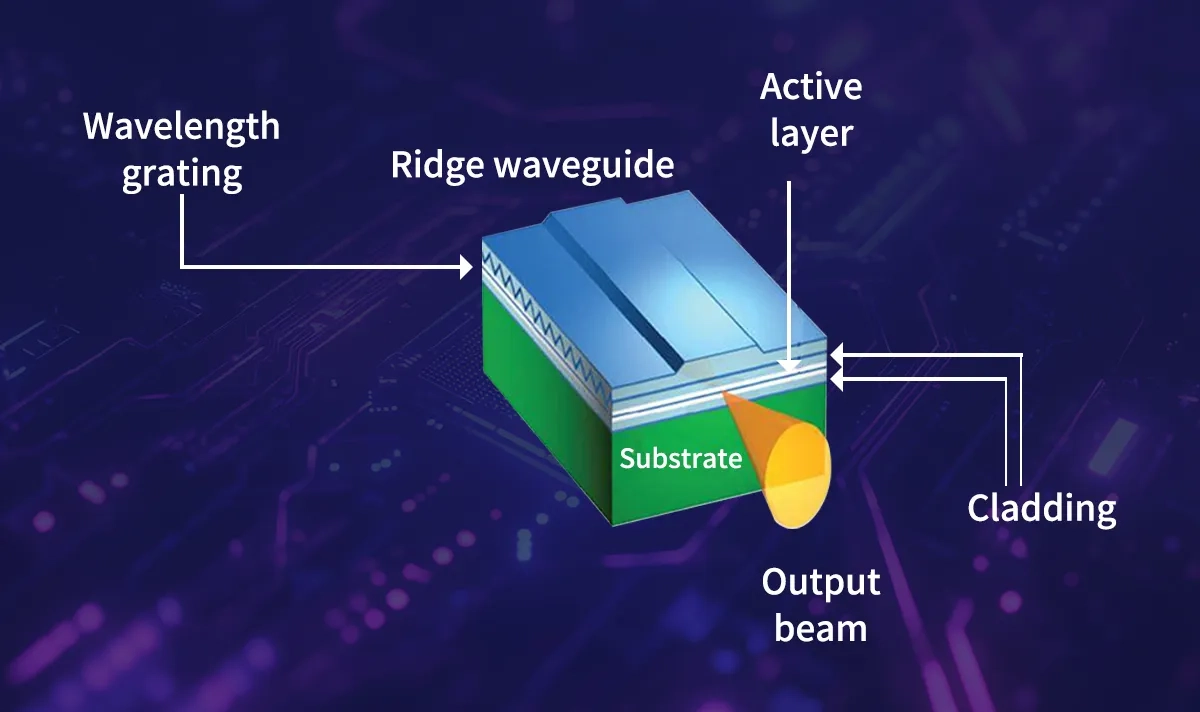
A DFB laser is a special semiconductor laser. Instead of using simple mirror-like ends, it uses a tiny built-in grating inside the chip to pick only one wavelength. Scientists first showed this idea in the 1970s, and after 2000 it became common in real products. It fixed the jumping-wavelength problem that older lasers had when temperature or current changed. Right now, nearly every fast optical module uses DFB technology because only one clean wavelength lets light travel 10 km to 80 km through fiber without big errors.
Structure and Features
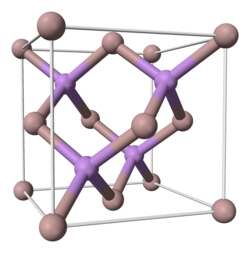
Every good DFB laser begins with the right base material. Almost all lasers that work between 1270 nm and 1610 nm use Indium Phosphide (InP) because InP is a direct-bandgap material. Electrons move fast inside it, and it turns electricity into near-infrared light very well, exactly the light that glass fiber likes most. For cheaper and shorter links, some companies still choose Gallium Arsenide (GaAs), especially for wavelengths shorter than 1100 nm.
Built-in Bragg Grating Design
The most important part is a very small periodic grating placed right above or next to the light-making area. This grating sends back only one exact wavelength and lets the others leak away, so the laser can only work at that single color.
Active Region and Material Selection (InP vs. GaAs)
Today’s chips use many thin quantum wells that are carefully stretched on InP to make light at 1310 nm O-band or 1550 nm C-band. DEEPETCH grows these crystal layers inside their own factory, so they can perfectly control light strength, linewidth, and how much the wavelength moves with heat.

High-Reflection and Anti-Reflection Coatings
One end of the chip gets a mirror that reflects more than 90% of the light, while the front end gets a special coating that lets almost all light go out. This simple trick gives you much more useful light while the inside grating still keeps everything stable.
Working Principle
When you send current into the chip, electrons and holes meet in the active area and make photons. Those photons travel back and forth, yet only the color that matches the grating pattern gets stronger and stronger.
Distributed Feedback Mechanism via Grating
The distance between grating lines decides the color by the simple rule λ = 2 n_eff Λ. A tiny change in heat or current changes n_eff a little, so the wavelength moves about 0.1 nm for each degree or 0.01 nm for each extra mA.
Single Longitudinal Mode Selection and Side-Mode Suppression
Good chips keep unwanted side colors more than 45 dB weaker, sometimes even 55 dB weaker. That means even when the laser switches on and off 25 billion times per second, no extra colors appear to make noise.
Temperature and Current Tuning Characteristics
You can easily shift the color 4-6 nm by warming or cooling the chip, or move it a couple of nanometers by changing current. This ability is very helpful when many different colors must travel together in the same fiber.
Performance Advantages
Excellent Side Mode Suppression Ratio (SMSR > 45 dB)
Such a clean signal keeps error rates lower than one in a trillion bits even after the light has traveled 80 km.
Narrow Linewidth and Low Chirp for Long-Distance Transmission
The light wave stays thinner than 1 MHz wide and chirp stays below 2, so 100G PAM4 signals can still reach 40 km without expensive extra modulators.
High Temperature Stability and Low Power Consumption
Special industrial-grade chips work without trouble from -40°C all the way to 95°C. Current changes stay under 20 mA across that huge range, and the whole chip often uses less than 50 mW at room temperature.
Main Applications
- 10G/25G/50G/100G Data Center and Metro Networks: Most 400G modules still use four or eight 100G PAM4 DFB lasers because the technology is proven, reliable, and does not cost too much.
- 5G Fronthaul CPRI/eCPRI and 25G/50G DML Solutions: Phone companies all over the world choose 25G simple gray-light modules built around directly modulated DFB lasers because they keep delay small and prices low.
- Coherent Communication and Silicon Photonics External Laser (1310 nm/1550 nm O-band & C-band): Advanced coherent receivers and silicon-photonics chips need steady continuous light with almost no phase noise, and 1310 nm plus 1550 nm DFB chips give exactly that.
Development Trends
Higher Speed: 100G PAM4 and 200G per Lane DFB/EML Integration
Engineers already run tests at 106 Gbps and even 212 Gbps using direct modulation, preparing the road for future 800G and 1.6T modules.
Higher Integration: InP Platform Monolithic PIC and Silicon Photonics EML
New chips put the laser, modulator, and detector together on one small InP piece so the final module becomes much smaller and uses far less power.
Cost Reduction and Industrial Temperature Range (-40~95°C) Solutions
Real IDM factories such as DEEPETCH keep improving production yield and heat resistance, so customers no longer pay extra for chips that work in very hot or cold places.
Why Choose DEEPETCH DFB Laser Chips?
When you need parts today, perfect quality every time, and quick changes for your special project, only a true IDM factory can promise that. DEEPETCH grows its own InP and GaAs crystals, makes the waveguides, carves the gratings, coats the ends, and tests every single chip at high speed. They make more than two million chips each month. The most popular types (10G/25G 1270-1330 nm, 1290-1350 nm, 1310 nm, and 1550 nm CW) are always ready in stock. You can buy bare chips, chips on small carriers, or complete TO-Can packages. Every chip passes full reliability tests, and AEC-Q101 data is ready when your project needs it. Just send them a message for free samples, and you will quickly see why the biggest module companies trust them for their hardest jobs.
FAQ
Q1: What is the typical wavelength tuning range of a DFB laser chip?
A: By changing temperature, you usually get 4-6 nm movement. By changing current, you get 1-3 nm.
Q2: Can DFB lasers work reliably at 95°C without a thermoelectric cooler?
A: Yes, special industrial chips run from -40°C to 95°C, some even to 100°C, and still keep good power and clean signal.
Q3: What is the difference between DFB and EML for 100G PAM4?
A: DFB is simpler and cheaper for 10-40 km links. EML adds an outside modulator for reaches over 80 km and gives even less chirp.