
Power consumption is often that “hidden cost” that determines the success or failure of a project in today’s data centers and high-speed communication links. You might only focus on transmission rates at the start, but when thousands of transceiver chips work at once, heat and electricity bills stack up into a real headache. Choosing the right transceiver chip is no longer just about picking specs; it is about choosing a strategy to balance energy and performance.
The Foundation of Computing Power? Semiconductor Materials and Chip Technology
The bedrock of computing power lies in the base materials. Silicon (Si) enough for everyone? No, there are physical limits to energy efficiency for various applications. As the industry moves forward into new levels of efficiency, attention is given to the energy loss mechanisms inherent in the material properties of various semiconductor materials. In many cases, silicon is not the best choice; in fact, the future lies with compound semiconductors.
High Electron Mobility of Gallium Arsenide Substrates
Gallium Arsenide (GaAs) stands out in low-power fields because of its high electron mobility. In a weak electric field, electrons in GaAs move much faster than in silicon—roughly 8500 cm²/(V·s). This means signals move more efficiently with less current loss at the same voltage. For digital circuits that need frequent switching, this material is naturally more power-efficient than traditional silicon-based parts.
Power Efficiency Advantages of the IDM Manufacturing Model
If you are looking to control power from the source, a partner with a vertical integration model has the edge. Founded in 2019, DEEPETCH is a fabless semiconductor company efficiently delivering latest IDM (Integrated Device Manufacture) model values with design, manufacturing and packaging services all under one roof. This setup supports DTCO (Design-Process Co-Optimization), allowing engineers to tweak wafer process parameters to squash leakage current. Having served over 1,560 global clients, their ability to customize from the bottom up is something a standard foundry just cannot match.
Advanced Process Nodes for Low Static Power Consumption
Modern transceiver chips are moving toward 5-22nm FinFET or BCD processes. A core goal of these advanced nodes is cutting static power. When your equipment is idling or under low load, these tiny transistor structures block unnecessary current flow. This prevents your battery or power supply from wasting energy as useless heat.
The Pipeline of Computing Power? High Speed Optical Modules and Cable Solutions
If the chip is the heart, then transceiver modules and cables are the “pipeline” of computing power. In 400G or even 800G networks, every milliwatt saved is vital. You have to decide between Active Optical Cables (AOC) or direct attach cables, as the power gap between them can be massive.
Power Optimization in 400G and 800G Optical Modules
High-speed optical modules are power-hungry. The trend now is using highly integrated digital signal processing chips. By reducing the number of discrete components and improving photoelectric conversion, the power per bit in new 400G modules has dropped significantly. In the power-sensitive AI Industry, this is the most direct way to cut operating costs.
Energy Saving Benefits of Active Optical Cables
Active Optical Cables (AOC) perform great in short-distance interconnects. Unlike heavy copper cables, AOC uses VCSEL lasers and PIN detectors for lightweight transmission. It supports distances from 1 to 100 meters while using precise power control to keep bit error rates low without over-consuming electricity.
Strategic Stock Management for Rapid Power Upgrades
In real engineering, you often hit a wall when chip shortages force you to use high-power alternatives just to stay on schedule. By checking Chips in Stock, you get more room to breathe. Stable supply chains mean you can stick to the low-power models you actually planned for instead of compromising on efficiency just to meet a deadline.
Thermal Management Challenges? Liquid Cooling and Packaging Innovation
Thermal management is more than just adding a fan. Once you trim power to the limit, how you pull away the remaining heat decides the chip’s lifespan. Packaging technology is the “heat shield” here, and ceramic packaging in harsh spots is almost impossible to replace.
Enhanced Heat Dissipation with CDIP Ceramic Packaging
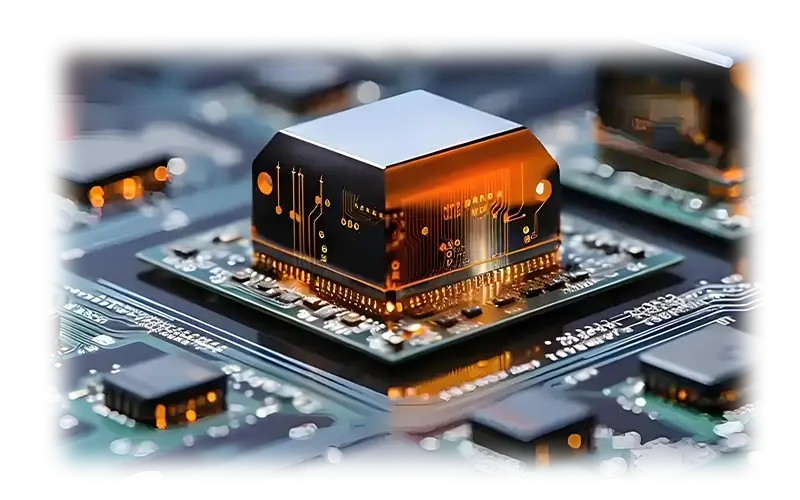
Ceramic Dual Inline Package (CDIP) stays popular for a reason. Using Alumina (Al2O3) or Aluminum Nitride (AlN) as the shell, it offers amazing thermal stability. For transceiver chips that must work at 200°C, CDIP pulls heat away fast. This stops temperature rises from increasing resistance, which would otherwise trigger even more power loss.
Superior Thermal Conductivity of Aluminium Nitride Substrates
Aluminum Nitride (AlN) substrates have thermal conductivity over 170 W/(m·K), much higher than standard materials. This high conductivity acts like a highway for heat. When a chip runs at high frequencies, AlN suppresses heat buildup at grain boundaries, keeping the energy efficiency ratio at its best.
Innovative Liquid Cooling Solutions for High Density Systems
When air cooling hits its limit, liquid cooling is the lifesaver. By bringing liquid cooling into the optical module package, you can remove heat exactly where it starts. The initial cost is a bit higher, but in the long run, it lowers the power used by the whole facility’s AC system. It’s a win for green computing.
Satellite and Radar Systems? TR Transceiver Chips and Modules
In extreme spots like satellite communications and radar, power is not just about money; it is about survival. A satellite has a tiny power budget from its solar panels. Every joule counts. Transceiver chips here need crazy high integration and smart power management.
Integrated TR Transceiver Modules for Aerospace Reliability
TR transceiver modules for aerospace must survive heavy vibration and cosmic radiation. These modules are packed into satellite payloads and must hit high performance within a tight power window. Using high-purity materials like 6N Indium or Arsenic helps keep noise floors and power draw low.
Power Scaling Techniques in Phased Array Radar Applications
Phased array radars use thousands of TR units. If each chip draws 10% more power than needed, the heat becomes uncontrollable. By using chips with low-power design logic, you can use dynamic power scaling. This lets the system adjust output based on how far away a target is, saving energy when full blast is not needed.
Radiation Hardened Designs for Stable Satellite Communication
Cosmic rays are chip killers. Radiation-hardened transceiver chips do more than prevent logic flips; they stop leakage paths from growing over time. This stability is key for gear that stays in orbit for years. If a chip starts leaking current due to radiation damage, your power budget goes out the window fast.
Terminal Applications and Ecosystem Positioning of Computing Power
Power-saving tech is spreading everywhere, from the Communications Industry to the palm of your hand. It is not just about the big servers; it is about the millions of tiny sensors in the Drone Industry or the critical monitors in Healthcare.
Power Sensitive MEMS Sensor Networks in Industrial IoT
Industrial sensors often run on batteries for years. Choosing a transceiver chip with an advanced “sleep mode” is non-negotiable here. These chips wake up, send data in a burst, and go back to a micro-ampere state. This is how you avoid sending a technician out to change batteries in a factory every month.
Seamless Integration in Smart Computing and AI Centers
AI needs massive data movement. In the Automotive world, self-driving cars act like mobile data centers. They need transceiver chips that handle LiDAR and radar data without draining the car’s main battery. Keeping the interconnects efficient means more range for the vehicle.
Future Trends in Multimodal Fusion and Edge AI Power Saving
The future is about “Multimodal Fusion”—combining temperature, gas, and pressure data into one stream. This reduces the number of transceiver chips needed, cutting the total power bill of the system. Edge AI also helps by processing data locally, so you only spend power transmitting the “important” bits.
Why DEEPETCH Is Your Ultimate Partner for Energy Efficiency
Having experience working high end technologies means also having experience in places such as research labs and actual field implementation. We have experiences collaborating with academic powers like Tsinghua University and Chinese Academy of Sciences. We are also experienced in collaborating with various high-end technology industrial players. Not just sales, we have extensive depth of experience in both academia and industries.
Proven Track Record with Global Leading Research Institutions
Collaborating with big units like CASC and CETC proves their chips can handle the “scary” stuff. Semiconductor Labs’ space tested semiconductors have been proven reliable on deep-space probes, high-speed trains, and space stations—on Earth and in space. Our transceiver chips for communication systems have withstood the rigors of harsh environmental conditions.
Comprehensive Quality Management and Compliance Standards
Efficiency is nothing without quality. Following IATF 16949 and ISO 9001 means every chip is consistent. You don’t want a “hero” chip that is efficient while the rest of the batch runs hot. Uniformity is the secret to system-wide power optimization.
Customized OEM and JDM Services for Unique Power Specs
Sometimes a catalog part just doesn’t fit. Their JDM (Joint Design Manufacture) service lets you co-develop a chip or module for your specific power constraints. If you have a weird form factor or a strict milliwatt limit, you should Contact Us to see what’s possible.
Conclusion
Finding the right transceiver chip is a mix of science and smart shopping. Gallium Arsenide Semiconductors, CDIP Packages and a manufacturer with semiconductor packaging experience all need to be considered in the selection process. Using our components, packages and manufacturing expertise we can ensure that your system is kept at the appropriate temperature, your power usage is minimised and your equipment is protected for longer life.
FAQ
Q1: Why does Gallium Arsenide save more power than Silicon?
A: Using GaAs semiconductors results, due to their higher electron mobility, in electrons that move faster. This results in lower AC resistance and reduced power dissipation during high speed switching.
Q2: Can CDIP packaging actually help with energy efficiency?
A: YES, Aluminum Nitride has high thermal conductivity which means it is efficient at removing heat from the chip die to keep it at its optimal operating temperature. This is particularly desirable in modern IC design as it prevents unwanted “power spikes” due to increased internal resistance as the die temperature rises.
Q3: What is the benefit of the IDM model for my project’s power budget?
A: An IDM handles design and manufacturing together. They can optimize the physical wafer process to match the chip design, which is much better for reducing leakage current than using a generic foundry process.
Q4: How do TR transceiver modules handle power in satellites?
A: They use high-purity materials and integrated designs to maximize gain while staying within a fixed power window. They often include smart scaling to adjust power based on signal needs, saving precious battery life in orbit.